
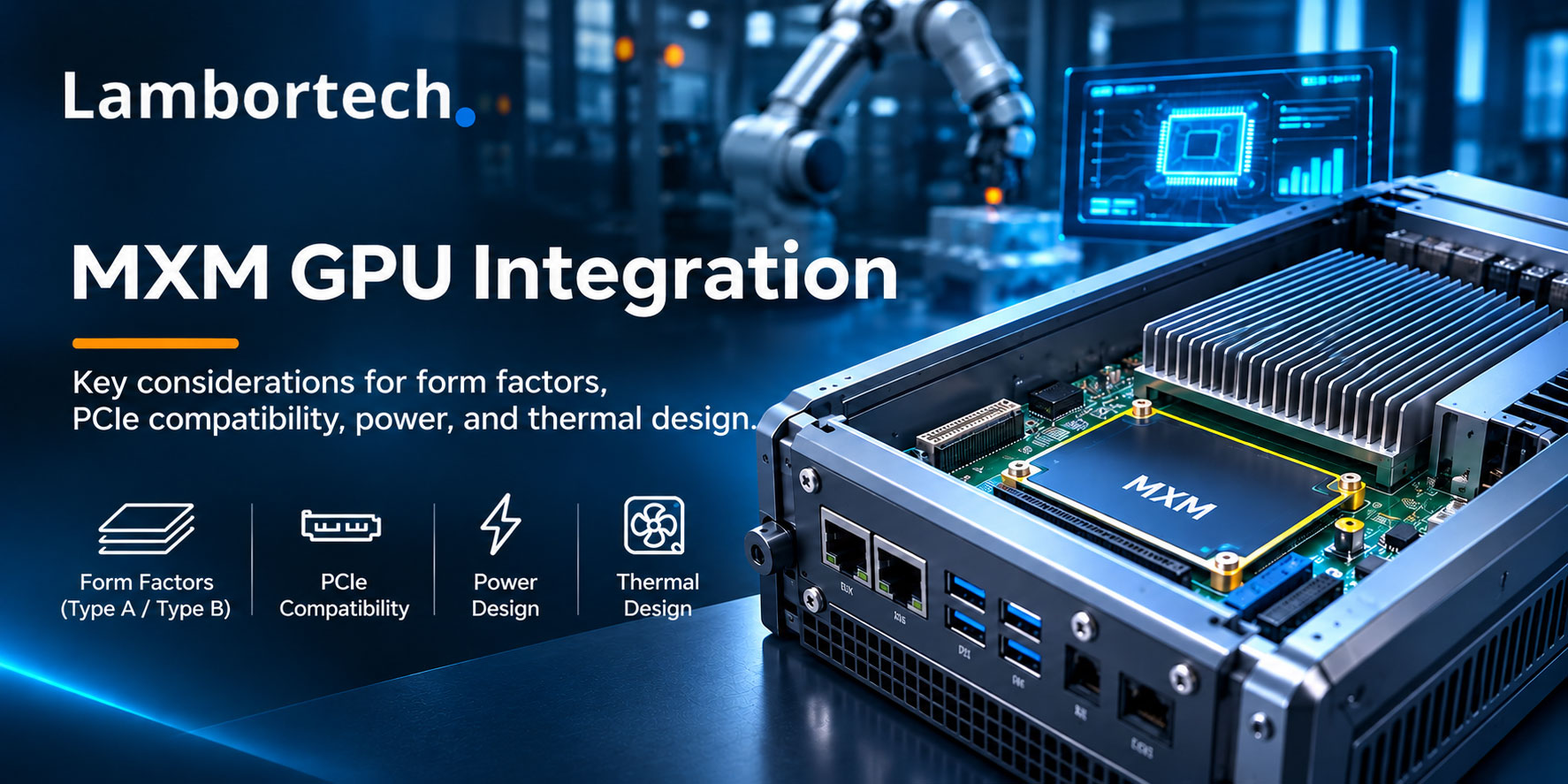
Integrating GPU acceleration into an industrial Edge AI system involves more than selecting a module based on processing performance. System integrators must also evaluate hardware compatibility, power requirements, thermal management, and software support to ensure the GPU operates effectively within the target platform.
MXM GPU modules provide a modular approach to GPU integration, but successful deployment depends on matching the module's requirements with the overall system design.
Understanding MXM Form Factors
MXM modules are available in different form factors, including MXM 3.1 Type A and Type B. These configurations provide different physical dimensions and integration options for compatible computing platforms.
Selecting the appropriate form factor requires consideration of available installation space, connector compatibility, mounting arrangements, and cooling requirements.
A module that fits within the available space may still require additional mechanical or thermal design adjustments. System integrators should verify the specific module dimensions and installation requirements before finalizing the platform.
PCIe and Platform Compatibility
PCIe connectivity is a critical consideration when integrating an MXM GPU into an embedded computing system.
The supported PCIe generation and lane configuration can affect data transfer capabilities between the GPU and host platform. However, interface compatibility involves more than matching PCIe specifications.
System designers should also evaluate motherboard support, firmware compatibility, available PCIe resources, and the intended operating environment.
Verifying these requirements early in development can help reduce integration challenges and avoid unnecessary hardware revisions.
Power and Thermal Design
GPU acceleration introduces additional power and cooling requirements that must be addressed at the system level.
Power consumption varies across GPU modules and operating workloads. The system power supply must support the selected GPU alongside the CPU, storage, networking, and other connected components.
Thermal design is equally important. Enclosure dimensions, airflow, heatsink configuration, and ambient operating conditions all influence the ability to maintain suitable operating temperatures.
For compact or fanless industrial systems, thermal integration can be particularly challenging. System designers should evaluate sustained workload performance rather than relying solely on peak GPU specifications.
Matching GPU Capabilities to Workloads
Different industrial Edge AI applications place different demands on GPU computing resources.
Industrial AI Vision: Image processing, AI-based inspection, and multi-camera analysis may require a balance of GPU processing capability, memory capacity, and data transfer bandwidth.
Robotics and Automation: Robotic perception and visual analysis can introduce real-time processing requirements that depend on the complete system architecture.
Edge AI Inference: Local AI model execution requires consideration of model size, inference throughput, memory requirements, and software compatibility.
Embedded GPU Computing: Parallel computing workloads may benefit from GPU acceleration, provided the selected module is supported by the host platform and application software.
Evaluating actual workloads helps system integrators select an appropriate GPU configuration without focusing exclusively on theoretical peak performance.
System Validation Before Deployment
Hardware compatibility is only one part of successful MXM GPU integration.
Software support, including GPU drivers, operating system compatibility, and application frameworks, should be verified for the intended platform.
System-level validation should also include sustained workload testing, thermal monitoring, power behavior, and application performance under representative operating conditions.
For industrial deployments, testing the complete system is essential because GPU performance and reliability depend on interactions between hardware, software, and the operating environment.
Conclusion
Selecting an MXM GPU for industrial Edge AI requires a system-level approach that balances processing requirements with mechanical compatibility, PCIe connectivity, power delivery, thermal management, and software integration.
By evaluating these factors early in development, system integrators can make more informed GPU selections and reduce potential integration challenges.
Explore Lambortech's MXM GPU portfolio to review available NVIDIA RTX PRO Blackwell and Ada Generation module options for industrial and embedded computing applications.
Explore MXM GPU Modules